
Jeffrey Bruno · The ExperienceReturn to the Experience
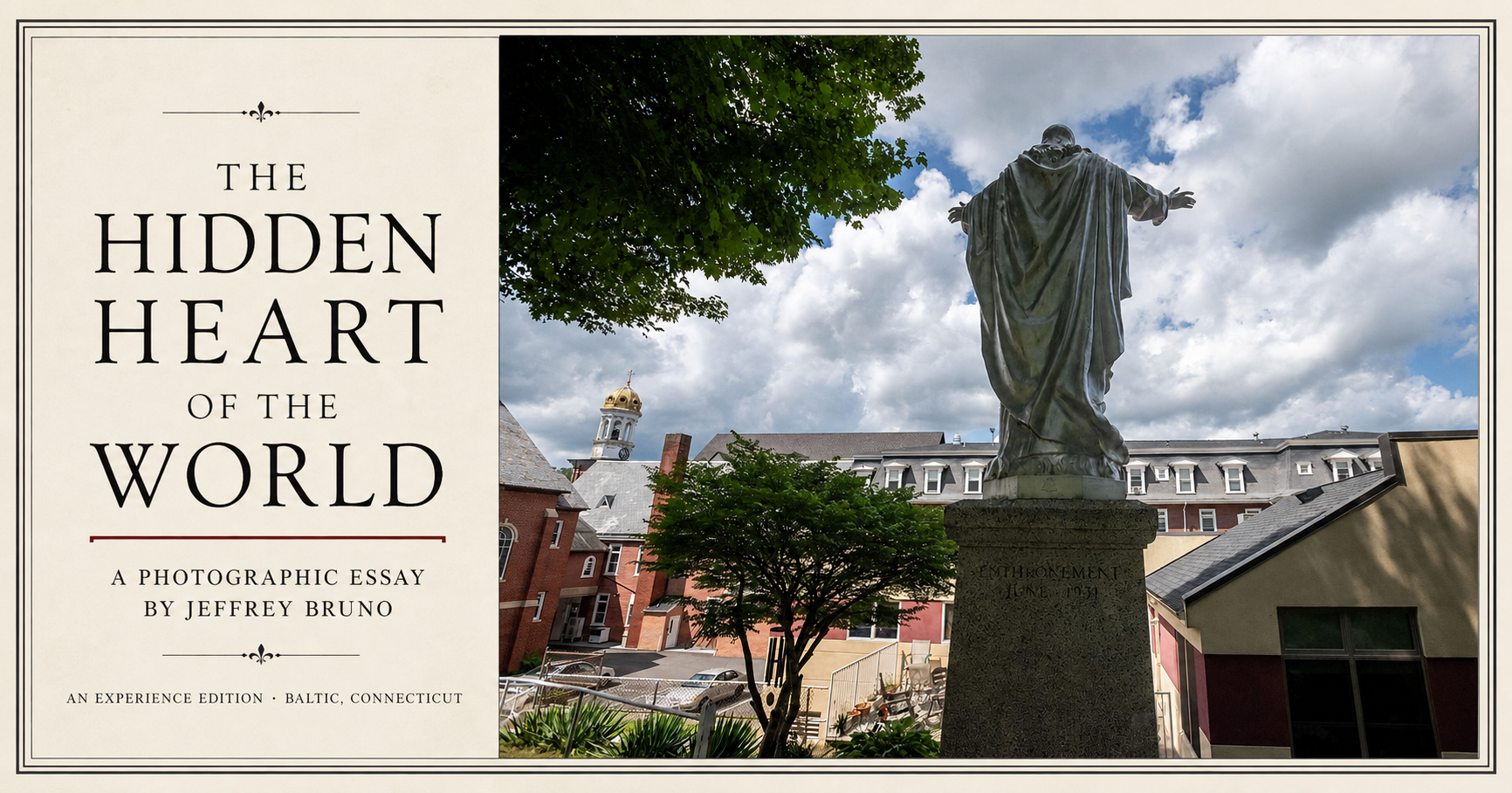
A statue overlooks the former mill village of Baltic, with St. Mary’s golden dome in the distance

An Experience Edition · Baltic, Connecticut

A photographic essay in three parts

The Hidden Heart
of the World

The mill fell silent. On the hill above Baltic, the bell kept ringing.

Enter the story

Words and photographs by Jeffrey Bruno

4:45 a.m.

Down in the basin, a thick white fog lay over the village. Above it, the worn gold dome caught the first light.

I

Chapter I · April 28, 2026

The Mill and the Hill

In a forgotten Connecticut village, one sound never stopped.

4:45 a.m.

The glow of my phone cut through the dark as I groped across an unfamiliar nightstand and, in my half-awake state, hit dismiss instead of snooze. So much for fifteen more minutes of bliss.

I rolled out of the unfamiliar bed and shuffled toward an unfamiliar kitchen, praying there was coffee and that I’d find it before I walked into a wall. Outside, somewhere beyond the thin pane of glass, a new day was already pushing at the edges of the night.

Baltic, Connecticut.

A tiny former mill village tucked into the rolling hills along a narrow river. A place you could easily miss if you were driving too fast on a gray Tuesday… and yet a place that has lived more than one life.

I peered out the east-facing window and watched first light arrive, that moment when the sky shifts from black to not-quite-black and the world remembers that morning is, in fact, going to happen again.

Down in the basin, a thick, white fog lay over the village like a blanket. The tall pines climbed out of it, their shadows stretched long by the low sun. Dew clung to every needle and blade of grass, catching the first stray rays and turning the hillside into a field of tiny stars.

And then, there it was.

The golden dome of the church rising above the trees, catching the sun head-on. For a few seconds it didn’t just reflect the light. It seemed to throw it back, a small sun of its own. The cross on top burned like a spark against the pale sky.

Somewhere below, the river moved quietly past the bones of what used to be one of the largest textile mills in eastern Connecticut, a sprawling complex that once drew workers from across the region, its brick walls humming day and night with the rhythm of looms. Entire families built their lives around it. Generations passed through its doors. The whistle marked the hours. The river powered the work.

This whole village rose and fell with that engine of industry. When the mill surged, Baltic filled with life, boarding houses, shops, children in the streets. When fire or decline came, and it did, more than once, the silence that followed settled just as deeply.

A distant train whistle cut through the stillness, thin and lonely.

A lone dove settled on the lip of the last standing smokestack…a soft gray comma against the red brick.

Up on the hill, the fog kept lifting.

And then another sound shouldered its way into the morning.

The bell.

6:30 a.m., and the bell of the Holy Family Motherhouse rang out across the valley…clear, insistent, unembarrassed. In a town where most of the old factory whistles have gone silent, the church bells still ring.

Inside, the Sisters of Charity of Our Lady, Mother of the Church were already moving down the halls, black habits brushing against polished floors, rosary beads clicking softly like distant rain.

I hadn’t come to Baltic as a tourist.

I came for the Sisters.

The Mill Town and the Motherhouse

I met the Sisters first in the chapel and the dining room—through their voices, their laughter, their joyful way of moving through a day. The town came later.

One afternoon, when there was a rare lull in the schedule, I took a walk into town.

From the hill where the Motherhouse sits, you can see almost everything. Rooftops, trees, the thin silver scratch of the river cutting through the valley. But it’s only when you start walking down the winding road that the past comes into focus: cracked pavement, sagging fences, old stone walls with nothing left to hold up.

At the bottom of the hill, the river slid by like it had all the time in the world. The ruins along the water suggested a different story. Brick foundations swallowed by weeds, rusted pipes jutting out of nowhere, two lone smokestacks punching into the sky like exclamation points from another era.

You could almost hear it if you stood still long enough.

The thunder of looms. The shriek of belts and pulleys. The constant hiss and clatter of thousands of spindles spinning cotton into thread.

Baltic grew up around that sound.

By the time I retraced my steps up the hill, I had more questions than answers.

The answers didn’t come all at once. They surfaced slowly, in conversation, in memory, in the way the Sisters spoke about the town as if it were still alive.

Later that day, I had followed two of them down to the food pantry at the edge of the property. It wasn’t large, but there was a steady movement of people coming and going. Out back, they showed me the truck they use to gather and deliver food, an old, retired rental, now pressed quietly into a different kind of service.

Nothing about it felt extraordinary.

And yet… everything about it did.

There was a constancy to it all.

A sense that while the town below had emptied of the noise that once defined it, something else had taken root in its place.

Not loudly.

But faithfully.

By the time I reached the top of the hill again, one thing was clear.

The mill had powered the town.

But on the hill, the bell kept ringing…

And alongside the old brick lines of the mill, the Motherhouse remains full of life. The daily life of the Sisters continuing just as steadily as the looms once did. And just beyond it, the worn gold dome of St. Mary’s still catches the light.

Plate VIBefore the valley fell silent, it looked like this.

Brick stretched across the horizon, row after row of windows catching the day’s first light. The smokestacks stood like sentinels, pushing out the work of a thousand hands.

Plate VIIAnd this wasn’t just a building…it was the reason the town existed at all.
Plate VIIIAnd this is what remains. The looms are gone. The buildings are gone. The noise has long since faded. But two smokestacks still stand, rising above the trees like quiet witnesses to everything that once filled this valley with life.
Plate IXThe tracks remain. Steel lines cutting through the valley, pointing forward as they always have… but no longer carrying the weight they once did. No schedules. No urgency.
Plate XJust distance.
Plate XIIt’s hard to imagine what once filled this valley.
Plate XIIWhere machines once roared and smokestacks marked the sky, the river now moves quietly between walls of green. The trees have returned, patient and unhurried, covering what industry once claimed.
Plate XIIIThe mill’s story was one of rise and ruin. But the Sisters’ story is something else entirely.
Plate XIVIn the place of noise came prayer. In the place of smoke came song. And in the shadow of what was lost, the Sisters of Charity of Our Lady, Mother of the Church remain a living witness that God is still making something beautiful here.
Continue to Chapter IIA Day Inside
II

Chapter II · April 30, 2026

A Day Inside

What the life of a hidden community actually looks like.

If the town below tells you what was once visible, a day inside the Motherhouse reveals what’s hidden.

From the outside, the Holy Family Motherhouse rises above Baltic with a quiet authority. It’s not dramatic in the way a cathedral is dramatic. It doesn’t overwhelm the senses. It simply stands there, solid and watchful, looking out over a valley that has seen smokestacks, immigrant families, schoolgirls, weddings, funerals, First Communions, and generations of Sisters moving through the same halls in white habits and black veils.

The Motherhouse is connected to the Academy of the Holy Family, the school founded by the Sisters in Baltic in 1874. The present school building, built in 1914, feels like part of the same long sentence, joined physically and spiritually to the Motherhouse beside it.

But inside, it’s less a building than a small world.

A corridor opens into another corridor. A stairwell turns unexpectedly. A hallway that seems to be leading one way suddenly reveals a chapel door, a sitting room, a relic case, a classroom wing, a kitchen, a dining room, or a quiet corner.

The Motherhouse is a labyrinth of passageways and sections, the kind of place where you begin to suspect that a map might just prove handy, if you were in any kind of hurry.

By the time I slipped into the chapel early on the second morning, the Sisters were already in place.

Rows of veils.

Heads bowed.

The soft rustle of pages turning.

“Lord, open my lips…”

“…and my mouth will proclaim your praise.”

The words rose and fell like breathing.

Above the altar, a great mural of the Holy Spirit seemed to gather the whole chapel beneath its wings. It felt like a presence. The dove hovered over the sanctuary, over the tabernacle, over the Sisters in choir, over the worn wood and folded hands and bowed heads.

And with every sunrise for over 150 years, the Sisters were doing what they do every day: standing before God on behalf of a world that mostly doesn’t know they exist.

Light from the stained-glass windows moved slowly across the floor.

A young Sister sang with her eyes closed. Across from her, an older Sister leaned heavily on the wood of the pew, her hands marked with age.

Two ends of the same rope.

Between them was the whole mystery of religious life: not escape from the world, but a long fidelity within it. A richer one.

After Morning Prayer and Mass, the silence of the chapel gave way to the gentle commotion of community life: cups being filled, chairs scraping against the floor, quick footsteps in the hallway, the low murmur of conversation, and laughter rising from somewhere just out of sight.

“Did you get your coffee yet?” one Sister asked, spotting me hovering with my camera, feeling a little out of place.

A few minutes later I was in the kitchen, fielding questions about where I’d come from, who I work for, how many kids I have. One Sister wanted to know why anyone would voluntarily live in New Jersey. Another assured me they would pray for me.

I’m still not entirely sure if the two comments were related.

That was one of the surprises of the Motherhouse.

You arrive expecting silence, and there is silence. Deep silence. Holy silence.

But there’s also laughter.

There’s teasing.

There’s the unmistakable sound of women who have lived together long enough to know one another’s habits, timing, weaknesses, favorite chairs, preferred coffee, and best jokes.

The day didn’t unfold like a program. It unfolded like a household.

One minute I was standing in a dishwashing room where steam rose from the machines. The next, I was in a hallway watching one Sister pause beside an elderly member of the community, adjust a blanket, offer a few quiet words, and draw out a tired but very real smile.

Elsewhere, school life continued on the other side of the connected buildings. Students passed through the same larger world of prayer, discipline, and formation that has shaped young women here for generations. The Academy is not a memory preserved under glass. It’s still a school. Still regular and boarding. Still alive with the ordinary hopes and worries of students who probably don’t realize, at least not yet, how much history surrounds them.

And then there were the relics.

Tucked within the Motherhouse is a remarkable collection as if the saints themselves had taken up residence in the walls. Tiny fragments of holy lives rested behind glass. Names from across the long story of the Church stood silently in their cases, not as curiosities, but as company.

That’s what the Motherhouse began to feel like to me.

A sacred community.

The Sisters in the chapel.

The students in the school.

The saints in their reliquaries.

The town below.

The river still moving silently through the valley.

And Holy Spirit overshadowing, protecting, and shining His Grace upon it all.

It would be easy to call this place a remnant of another age, but that would be the wrong word. A remnant is what’s left over.

This is not left over.

This continues to move, and remains.

“What do you want people to know about your life here?” I asked one of the Sisters.

She paused.

“That it’s real,” she said. “People imagine a museum. But this is very alive.”

That sentence stayed with me because it named exactly what I’d been seeing.

Inside the Motherhouse, hidden above a former mill town in eastern Connecticut, Grace was not only surviving.

It’s moving through the halls.

It’s laughing over coffee.

It’s singing beneath the Holy Spirit.

And it’s caring for the old, teaching the young, feeding the hungry and passing quietly from one generation to the next.

Faithfully.

And that’s been the story of Grace from age to age since the beginning. And in this sleepy town of Baltic, there’s no exception.

Plate XVIIIBefore the Motherhouse begins to move, it gathers in silence.

Rows of black veils face the altar, each Sister hidden from view and yet fully present, joined in the prayer that has carried this community through generations. In the Motherhouse, the day does not begin with activity. It begins with Christ.

Plate XIXA Sister bows over her prayer book as the community prays the Divine Office, the kind of hidden work that leaves no noise behind, but somehow holds everything else together.
Plate XXAt the center of the house is not a memory, or a mission statement, or even the long history of the community. It is Christ himself, lifted above the chalice in the silence of the Mass, the source from which everything else flows.
Plate XXIAn elderly Sister prays the Stations of the Cross daily from her wheelchair before the altar, framed by stained glass and morning light. In the Motherhouse, fidelity is not measured only by movement, but by remaining.

In the kitchen, the sacred and practical sit side by side: steel pans, an old scale, flowers, an American flag, and a small statue of Our Lady watching over it all. Here, Grace does not float above ordinary work. It settles in among the pots and shelves.

Plate XXIIIThe life of the house moves through the kitchen as naturally as it moves through the chapel. Meals are planned, dishes are washed, questions are asked, and the ordinary work of feeding one another becomes part of the larger prayer.
Plate XXIVOn the school side of the Motherhouse, a Sister writes an equation on the board while students follow from their desks. The Academy of the Holy Family is not a preserved memory. It is still a school, still forming young women under the same roof where generations have prayed.
Plate XXVIn the refectory, the pace loosens. Between prayer and work, there is the quiet companionship of women who have shared years of service, carrying in their faces the peace of a life given steadily, day after day.
Plate XXVIThe halls of the Motherhouse are not solemn all the time. Around corners and on stair landings, laughter breaks open the silence, revealing a community as human as it is holy.
Plate XXVIIIn the food pantry, cans of food become a different kind of liturgy. Hands sort, stack, count, and prepare, making sure someone hungry will be fed. The prayer of the chapel does not stay in the chapel. It moves toward the next person in need.
Plate XXVIIIA Sister prepares candles and devotional vessels by a window, the small mechanics of prayer laid out on a worktable. Even here, in the unnoticed tasks, the life of the chapel is being tended.
Plate XXIXA Sister pushes an elderly member of the community down a long corridor beneath crucifixes and holy images. The hallway becomes a procession in miniature: one Sister serving, one Sister being carried, both moving through a house built on Love.
Continue to Chapter IIIWhat Endures
III

Chapter III · May 2, 2026

What Endures

When everything visible fades, something else remains.

Two long days later, after the last prayers, my bags packed, and I took a long look at the tiny cabin high up on the hill that I would depart from in the morning, I stepped outside for some air.

The valley that had been wrapped in fog on that first morning now lay under a clear sky adorned with stars. The dome of the church caught the moonlight, softer now, but still impossible to miss if you knew where to look.

Down by the river, the ruins of the mill were just barely shadows and edges against the faint glow of the town.

It struck me how easy it would be to drive past all of this and never know what you were missing.

From the highway, Baltic is just another name on a green sign. From a distance, the Motherhouse could be mistaken for any large brick building on a hill.

But if you step inside, if you rise at 4:45 a.m. and fumble for coffee and watch the fog lift off the valley, if you listen to the bell, sit in the chapel, follow a Sister through her day, you start to see something else…

“What do you want people to know about your life here?”

“That it’s real.”

Those words will forever live with me.

Because what I had seen over the course of those days wasn’t an artifact of the past or a remnant of something fading.

It was life at its fullest.

The life of Grace.

A breathtaking gift from a Merciful and Loving God.

The Sisters of Charity of Our Lady, Mother of the Church are one small current in a much larger, often unseen ocean of Grace, lived out in places like this, far from headlines, and in every hidden corner of this vast world.

They didn’t save the mill. They couldn’t stop every factory closure or every family from moving away.

That was never their work.

Their work was, and is, to love…

To love God who called them.

To love the Church that formed them.

And to love the people placed in front of them in this little valley, in this particular sliver of time.

As I stood there looking at the dome and the smokestack, one gleaming, one crumbling, it was hard not to see them as a kind of parable.

Human projects rise, dominate, and fall. Technologies replace what came before. Brick and iron eventually crumble and rust away.

But the work of Grace, the daily “yes” whispered in convent chapels, over kitchen sinks, and in the middle of ordinary days, that’s what endures.

You could say Baltic is just a small town with a long-closed mill and a house full of nuns.

Or you could say it’s something else entirely.

That the life of the Church isn’t sustained by mills, wealth or any other worldly thing, but by those whose faithfulness, animated by Grace, persevere through it all.

So if you ever find yourself on a back road in East Connecticut and you hear a bell cutting through the fog at dawn’s early light, don’t be too quick to keep driving.

Slow down. Look toward the hill.

Because somewhere up there, the Church is awake and praying for you.

And the Hidden Heart of the world, is still beating.

The Sisters

The Sisters of Charity of Our Lady, Mother of the Church

Learn more about them on their website and follow them on Instagram and Facebook!

There’s one in every bunch

Still on the hill

The hidden heart
is still beating.

An Experience Edition

Words & Pictures by Jeffrey Bruno

Adapted from the original three-part series, first published in April and May 2026.
Visit The Jeffrey Bruno Experience